
New Year's Carols: Customs Across Greece
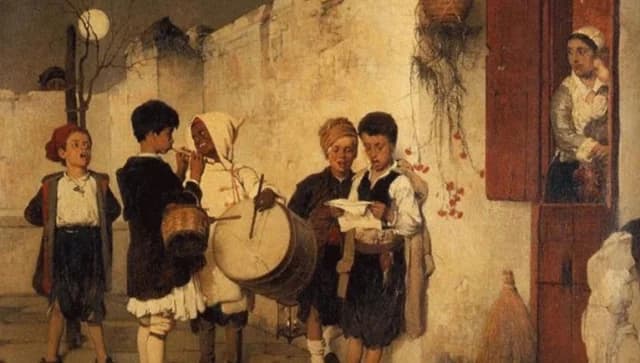
New Year's carols are traditional songs with roots in Ancient Greece, sung on New Year's Eve in many regions of Greece. Typically, carols are sung by children and teenagers, as well as adults, who visit homes, shops, and public spaces.
The carolers are accompanied by the traditional triangle, as well as other musical instruments such as harmonica, accordion, drum, and flute. Before starting, they ask if they are allowed to sing and, after an affirmative answer, begin the recitation.
The purpose of the carols is to wish "Happy New Year" and receive a treat, either in money or in products. In various regions, such as Veria and Siatista, a special bun is prepared, called kolliki or kuliantina.
Different variations of carols are found in various regions of Greece, such as Zakynthos, Asia Minor, Macedonia, Thrace, the Aegean islands (Ikaria, Corfu, Chios), Pontus, Kefalonia, Crete and Epirus. Each region has its own unique lyrics and melodies.
In Zakynthos, the carols focus on wishes for health, love, and joy. In Asia Minor, children held trombones and boats, while in the islands, carolers praise the listener more.
In Pontus, the carols are accompanied by local musical instruments such as the bagpipe, the Pontian lyre, and the flute.